
What black mould is in UK homes
When people in the UK say black mould, they usually mean the dark grey to black spotting that appears on walls, ceilings, window frames and bathroom sealant, mostly in autumn and winter.
It is nearly always a condensation story. Warm, moist air from showers, cooking, drying washing and breathing meets a cold surface, turns back into water, and mould grows where that water sits. That is why it turns up in the corners of bedrooms, round windows and behind wardrobes against external walls.
The species people mean when they talk about toxic black mould is Stachybotrys chartarum. In reality, lots of different moulds look dark on a wall, and you cannot tell which is which by eye. For cleaning purposes it does not matter much: you treat them the same way.
Does black mould need a special black mould spray?
Not a special one, but a suitable one. You want a remover that works on the dark moulds, is safe on the surface you are treating, and is safe to use in a lived in home. Many bathroom sprays are strong, bleach-based products written for tiles. They work on tiles. On painted walls, plaster and bedroom ceilings they are a poor fit.
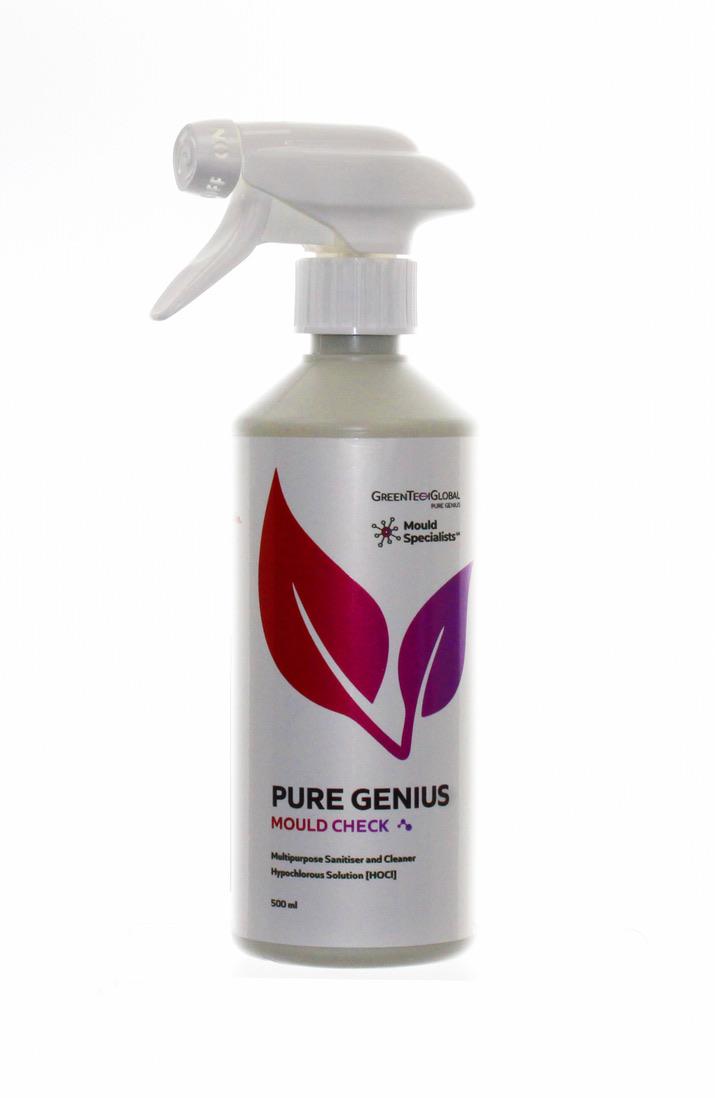
Our black mould remover spray, Mould Check, is hypochlorous acid at pH 6 to 7. To the BS EN 1650 standard, hypochlorous acid achieved 100% removal of common household moulds including Aspergillus niger, Penicillium and Stachybotrys chartarum. It has no harsh fumes, is COSHH free, and is safe on painted walls, ceilings, wallpaper, sealant, grout and window frames.
Why bleach only lightens black mould
Bleach is sodium hypochlorite, and it is excellent at removing colour. That is exactly why it looks so convincing on black mould: the spots fade within minutes. On a hard tile, it does kill the mould. On porous plaster, paint and silicone, the growth below the surface can survive, and the black comes back in the same place.
That does not make every alternative useless. Hydrogen peroxide at 6% or more works, and HG mould remover works on tiles. Here is how the usual suggestions compare. For the chemistry, read does bleach kill mould.
| What people suggest | What actually happens |
|---|---|
| White vinegarPartly | Acetic acid kills surface growth slowly. Does not remove the stain. Needs repeating. |
| Vinegar with lemon juicePartly | No better than vinegar alone. |
| Bleach and waterSurface only | Bleaches the pigment. On porous surfaces the growth survives. |
| Hydrogen peroxide, 6% minimumWorks | Genuinely effective, decomposes quickly, bleaches fabric and hair. |
| HG mould removerWorks | Works, and it is bleach-based, so the porous-surface limit applies. |
| Anti-mould paintPartly | Slows regrowth. Painting over live mould does not stop it. |
| New silicone sealantWorks | The right answer when the sealant is the problem, not the wall. |
Never mix bleach with other cleaners
Bleach mixed with vinegar or other acids releases chlorine gas, and bleach mixed with ammonia releases chloramine vapour. Use one product at a time and rinse between them.How to use a black mould remover spray, step by step
Before you start, have these to hand:
- Gloves
- Eye protection
- A window open
- A bin bag for cloths
- 01Gear upGloves and eye protection on, especially if you are spraying a ceiling or above head height.
- 02Do not dry brush itBrushing or scraping dry mould throws spores into the air and onto the next bit of wall. Always wet it first.
- 03Spray the whole patchCover the black spotting and a little beyond the edge, where growth you cannot see yet is starting.
- 04Leave it 10 minutesGive it time to work. Wiping straight away mostly moves the mould around.
- 05Wipe, turning the clothWipe clean with a damp disposable cloth, folding to a clean face each time. No rinsing needed with Mould Check.
- 06Bag the clothsPut used cloths straight into a bag and tie it, or wash reusable ones on a hot cycle on their own.
Check the area again after a week. If you see new spotting, treat it again and look harder at where the moisture is coming from.
Where black mould grows and how to treat each spot
Walls
Usually in corners of external walls and low down behind furniture. Spray, wait, wipe. On wallpaper, mist lightly and test a hidden patch first.
Choosing a mould remover for wallsCeilings
Cold corners above external walls and over showers. Eye protection matters here. Spray in short bursts so it does not run, and wipe with a cloth on a mop head.
Window frames and seals
Condensation runs down the glass and sits on the frame and rubber seals. Treat the frame and the seal, then dry the windows every morning in winter.
Silicone sealant
Black spots in bath and shower sealant are often inside the silicone. Spraying can lift the surface, but if the dots are under the skin, replacing the bead is the honest fix.
Mould on sealant and groutBehind furniture
Wardrobes and beds against cold external walls trap still, damp air. Pull them out, treat the wall and leave a gap of a few centimetres when you push them back.
Clothes and soft furnishings
Be careful. A spray will not get mould out of fabric fibres. Wash clothes and curtains on the hottest cycle the label allows. Mouldy mattresses, cushions and carpets often need replacing.
Black mould and health, in plain terms
Black mould is not something to live with. It can trigger or worsen breathing problems and allergies, and some people are more affected than others: babies and children, older people, and anyone with asthma, other lung conditions or a weakened immune system.
If you or someone in your home has symptoms you think could be linked to mould, speak to your GP or call NHS 111. In an emergency, call 999.
Removing the mould and fixing the damp is what helps. A cleaning product is not a treatment for anyone's health, and we make no health claims for ours. What we can say is that Mould Check has no harsh fumes, so you are not adding a bleach smell to a room that someone with asthma has to sleep in.
Black mould in a rented home: renters and landlords
If you rent
- Tell your landlord in writing, by email or through their repairs portal, so there is a dated record.
- Take photos with the date, and keep copies of every message.
- Keep up the everyday things you control: ventilation, heating, drying washing carefully.
If you are a landlord
- Social landlords in England must act on damp and mould under Awaab’s Law.
- Find the cause: condensation, a leak, failed ventilation or cold spots.
- Use a product you can apply with tenants at home, without COSHH paperwork for the spray.
Housing teams and contractors often ask whether mould treatment needs a COSHH assessment. With a bleach-based product it usually does. Mould Check carries no hazardous classification, so no COSHH risk assessment is needed for it. It is used by the NHS and Clarion Housing, as well as St Leger Homes and Shropshire Towns and Rural Housing. Read more on our COSHH and mould page.
When to call a professional for black mould
A black mould spray is the right tool for patches you can reach and treat. Get professional help when:
- the mould covers a large area, or several rooms;
- it keeps coming back within weeks of treatment;
- there are signs of a leak, rising damp or water getting in;
- it is behind plasterboard, under flooring or inside fitted units;
- someone in the home is vulnerable and you need it dealt with quickly and properly.
 COSHH free
For the patches you can treat yourself: Mould Check
500ml from £12.99. 5L and 10L refills available.
- Non-toxic, bleach free
- Safe on painted walls
- Spray, wait 10 minutes, wipe
Black mould remover questions
Partly. Bleach kills mould on hard, non-porous surfaces like tiles. On porous surfaces such as plaster, painted walls and sealant, it lightens the stain so it looks gone, but the growth underneath can survive and come back. Our full guide, does bleach kill mould, explains the chemistry.
Because the moisture that caused it is still there. Black mould returns to the same cold corner, window reveal or patch behind the wardrobe because that is where condensation collects or where damp is getting in. Treat the mould, then fix the ventilation, heating or leak, or it will come back whatever product you use.
It can trigger or worsen breathing problems and allergies, especially for children, older people and anyone with asthma or a weakened immune system. It should be dealt with, not lived with. If you are worried about symptoms, speak to your GP or call NHS 111.
A small patch you are treating is not usually a reason to move out of a room, but the mould should be removed and the cause fixed quickly. If anyone sleeping there has asthma or breathing problems, or the mould covers a large area, move them to another room if you can and speak to a GP or NHS 111 about any symptoms.
Many are not, because they are bleach-based and give off strong fumes. Mould Check is hypochlorous acid at pH 6 to 7, COSHH free and has no harsh fumes, so it is safe to use with people at home, including children, pets and pregnant tenants. We still recommend gloves and eye protection when spraying.
With Mould Check, spray the area, leave it for 10 minutes, then wipe clean. No rinsing. Heavily stained or porous surfaces may need a second treatment once the surface is dry.
More on bleach in our full guide: does bleach kill mould.